THE JOURNAL
Hear what Jo has to say - on RTOs, programs, and building businesses that breathe.
Long-form, opinionated writing from thirty years in the sector. Story, strategy, transformation. New pieces every couple of weeks.
BSB80120 CRICOS Cancellation: What RTOs Must Do by 5 October
BSB80120 CRICOS cancellation: what to do before 5 October, and what it tells every RTO about self-assurance
A qualification has been closed to new overseas students, and non-completion was part of the evidence. Here is the dated action list for affected providers, and why ASQA's new Corporate Plan makes this everyone's business.
PART ONE · FOR PROVIDERS WITH BSB80120 ON CRICOS SCOPE
WHAT HAPPENED
The first course cancellation under the new ESOS power
On 3 September 2026, the Assistant Minister for International Education, the Hon Julian Hill MP, made a legislative instrument specifying BSB80120 Graduate Diploma of Management (Learning) (GDML) for automatic suspension and cancellation under section 96B of the Education Services for Overseas Students Act 2000. It was announced on 4 September.
It is the first use of the course suspension and cancellation powers added to the ESOS Act in December 2025. Those powers let the Minister specify a class of course after considering matters including systemic issues in delivery, alignment with Australia's skills needs, and the public interest.
The Government pointed to evidence that the qualification was being used to facilitate onshore transfers by non-genuine students, alongside high visa refusal rates and high non-completion rates.
Media reporting has placed the number of affected providers at more than 450 and affected international students at more than 25,000. Treat those as media figures rather than confirmed regulator figures.
THE KEY DATE
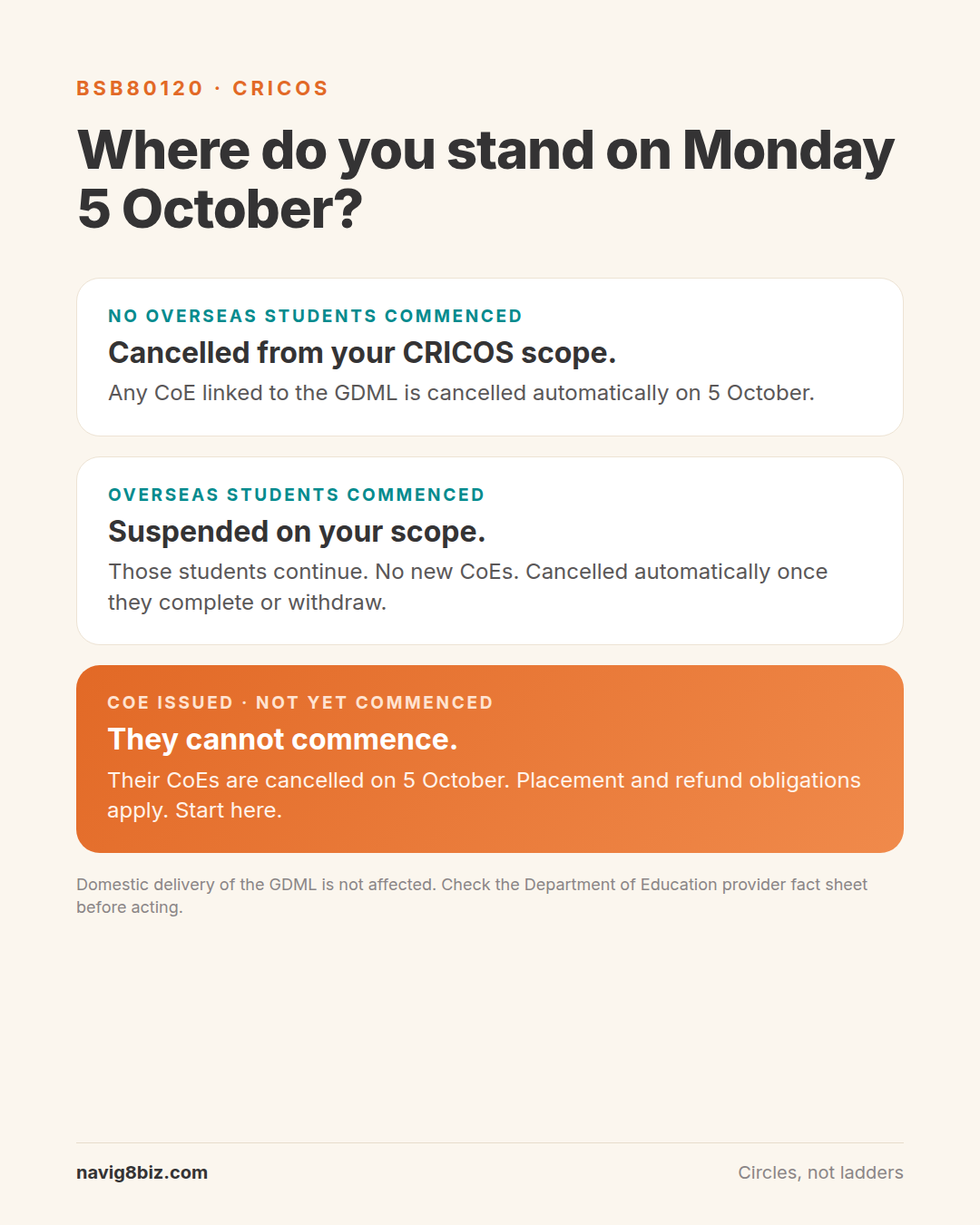
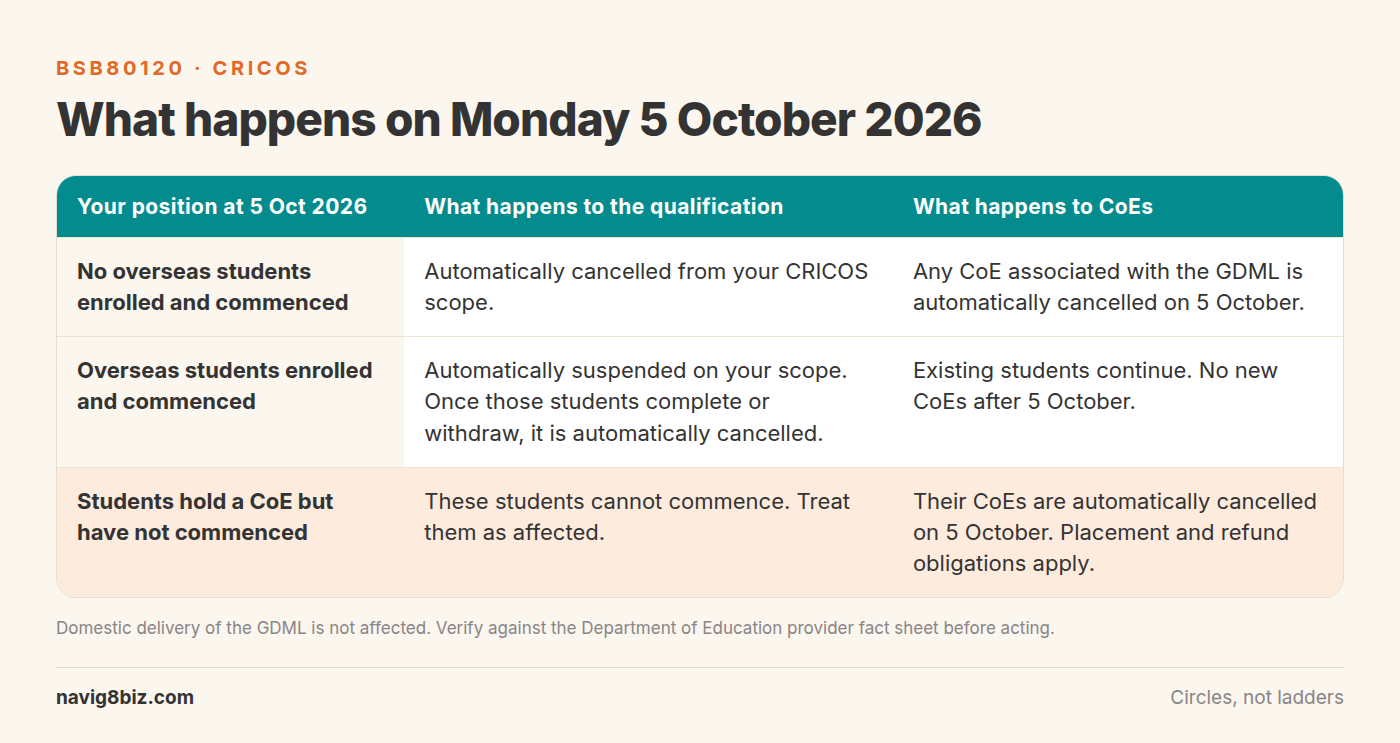
Monday 5 October 2026
From that date, CRICOS providers cannot:
•issue new Confirmations of Enrolment (CoEs) for the GDML
•enrol new overseas students in the GDML
•commence overseas students who have not yet started the GDML
Providers may keep delivering to overseas students who have already commenced by 5 October. While the instrument is in force, the qualification cannot simply be re-registered on CRICOS. Delivery of the GDML to domestic students is not affected.
YOUR ACTION LIST
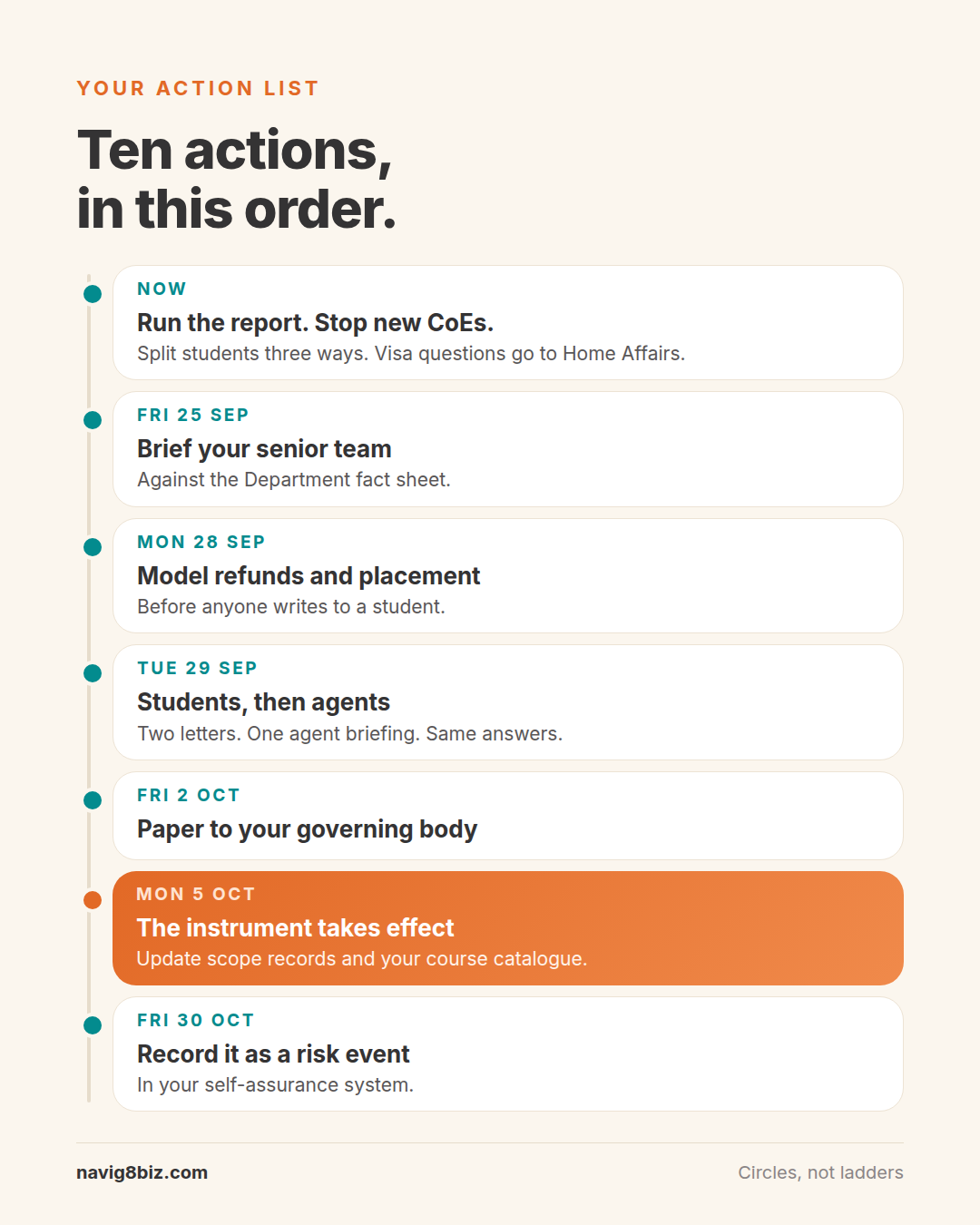
Ten actions, in this order
Dates assume you are starting from the week of 21 September. Most providers with the GDML on scope will have done the first two already. If you haven't, start there today.
The order matters. Model refunds and placement before anyone writes to a student: the letters depend on the numbers, so the numbers come first. And brief agents in writing, because agents giving different answers is how complaints start.
WHAT THIS DOES NOT CHANGE
Three things stay exactly as they were
•Your domestic GDML delivery. Domestic students are unaffected.
•Your registration. This is a course-level action, not a provider-level one.
•Your obligations to students already commenced. They are entitled to the same quality of delivery and support as before.
WHERE TO SEND PEOPLE
Keep every question in its lane
•Visa questions: the Department of Home Affairs, or a registered migration agent. Never your admissions team.
•Course cancellation detail: the Department of Education GDML provider fact sheet.
•Regulatory obligations: the ASQA newsroom item on the cancellation, and ASQA directly.
PART TWO · WHY IT MATTERS TO EVERY RTO
THE EVIDENCE BASE
Non-completion was not a footnote
It is tempting to treat all of this as an administrative scramble, close it out on 5 October and move on. Don't.
Look again at the reasons. Non-completion was not framed as a quality nicety or a student experience matter. It sat in the evidence base for removing a qualification from an entire market. For anyone who has spent years being told that completion is a business metric rather than a compliance one, that is a meaningful shift.
And a few days earlier, ASQA had published a plan that says the same thing in a different register.
MEASURE 1B.1
Self-assurance just went public
ASQA's Corporate Plan for 2026-27 to 2029-30, published on 31 August, carries a performance measure, 1B.1: providers publicly report the outcomes of their self-assessment activity. The targets run maintain baseline in 2026-27, then baseline plus 5%, then plus 10%, then plus 10%. The data comes from ASQA's Provider and Course Owner Survey.
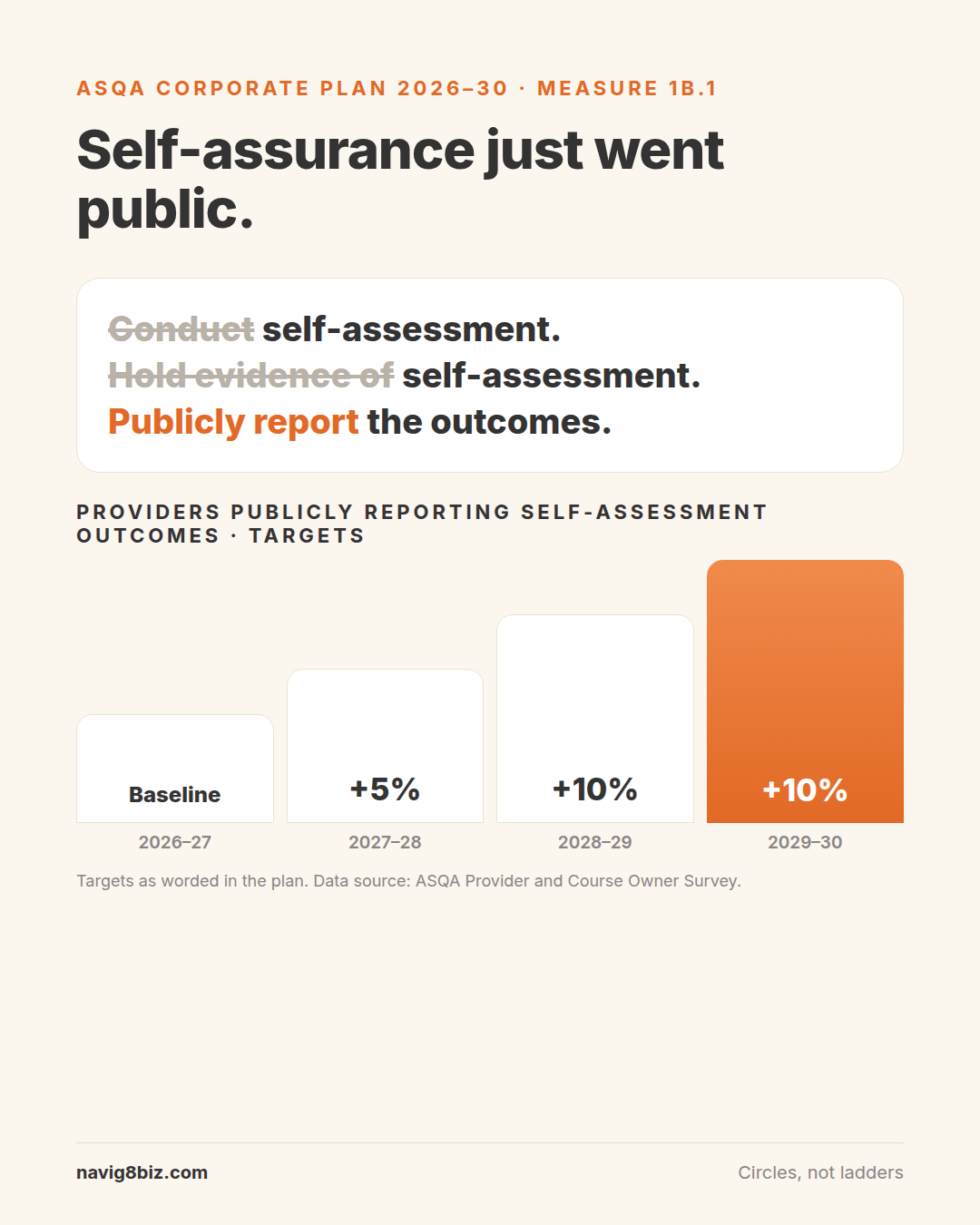
Read the wording carefully, because it is doing work. It does not say providers conduct self-assessment. It does not say they hold evidence of it. It says they publicly report the outcomes.
Self-assurance under the 2025 Standards was never meant to be a private file. But in the first year of the Standards, that is largely what it has become. Most of the quality systems I have seen built, including some very good ones, treat self-assessment as something you do so you have it when someone asks. The audience is the auditor. The output is a folder.
A system whose outputs you would be comfortable publishing is a different system from one whose outputs you file. The difference isn't the evidence. It is the honesty of the finding.
TWO DOORS
Genuine and non-genuine providers are measured separately
Measure 1A.2 tracks providers found through performance assessment not to be meeting the Standards who return to compliance by the end of the engagement, explicitly excluding those identified as non-genuine. Measure 1A.3 tracks whether ASQA's decisions to exit non-genuine providers hold up at external review: 75% this year, rising to 80%.
Genuine providers who fall short are a problem the regulator wants to help solve. Non-genuine providers are a problem it wants to remove. Which door you are standing at is largely settled before anyone arrives, by whether your systems produce a coherent account of what you do and why. Not a defence. An account.
VIABILITY
Provider viability is now on the regulator's risk register
The plan names provider financial viability and market instability as one of ASQA's key organisational risks. The mitigations include financial viability assessments and monitoring, early identification of distress indicators, and coordinated response with other regulators and funding bodies.
This is a regulator that expects some providers to fail and is building the instruments to see it coming. If your revenue is concentrated in a small number of qualifications or a single student cohort, as it is for many providers with the GDML on scope, that is now a compliance conversation as much as a finance one.
THE GOOD NEWS
The regulator has named compliance theatre as a risk to itself
Tucked into the same risk register is an entry many providers will find surprising. ASQA lists regulatory burden and unintended impacts of reform as a risk to its own objectives: the possibility that poorly timed or disproportionate regulatory action could impede provider capability uplift or worsen workforce shortages.
That is the clearest signal yet that the shift the 2025 Standards described, from prescriptive compliance to genuine outcomes-focused practice, is meant to be real. Providers still building thicker folders are optimising for a regulator that no longer exists.
BEFORE JUNE
Three things worth doing
None of this needs a system rebuild. It needs a change in what your system is for.
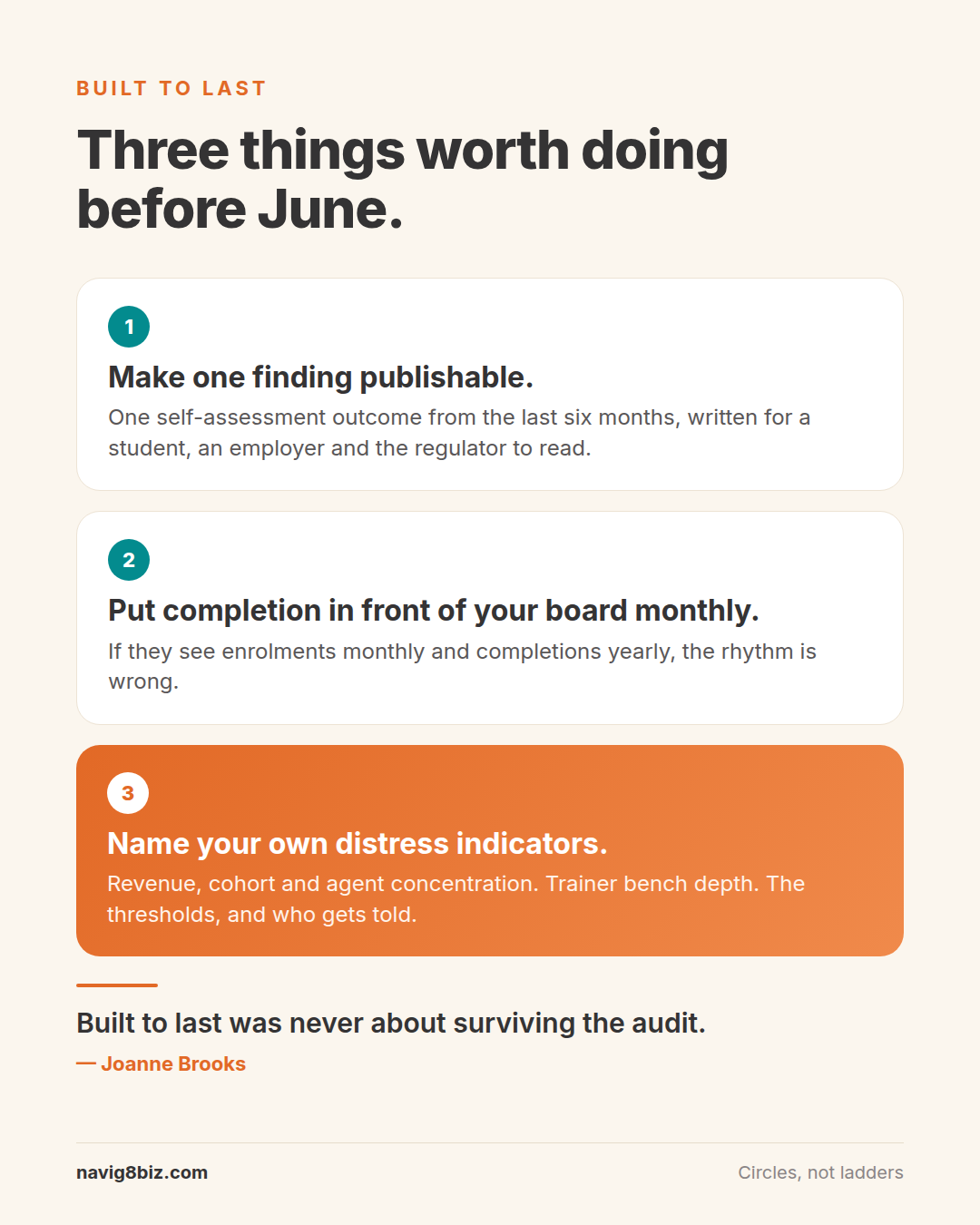
1.Make one self-assessment outcome publishable. Not the whole system, one finding. Pick one from the last six months and write it as you would if a prospective student, an employer partner and the regulator were all going to read it. If the honest version is unpublishable, you have learned the more useful thing.
2.Put completion in front of your governing body every month. Non-completion is now regulatory evidence at qualification level. If your board sees enrolments monthly and completions annually, that is the reporting rhythm of a provider that hasn't been paying attention.
3.Name your own distress indicators before someone else does. Revenue concentration, cohort concentration, agent concentration, trainer bench depth. Write down the thresholds that would worry you, and who gets told when one is crossed.
If you have the GDML on scope, action 10 on your list is where this starts. A provider that can show how it identified the risk, what it decided and what changed has a self-assurance story worth telling. A provider that quietly complied has an empty file. Same outcome for students. A very different position with the regulator.
WHAT TO WATCH NEXT
A template, not a one-off
•Whether further qualifications are specified. The stated criteria are broad, and the evidence leaned on completion and visa refusal data that exists for every qualification.
•How the instrument interacts with provider viability. Providers heavily weighted to this qualification will feel it in revenue, and the regulator has told us it is watching for exactly that.
QUESTIONS THAT MAY BE GOING ON IN YOUR HEAD
Can we still deliver BSB80120 to domestic students?
Yes. The instrument applies to CRICOS registration and overseas students. Domestic delivery is not affected.
What happens to overseas students who have already started?
Students who commenced before 5 October can continue and complete with their current provider. The qualification is suspended on your CRICOS scope until they finish or withdraw, then cancelled automatically.
Can we re-register the qualification on CRICOS?
Not while the instrument remains in force.
Does this affect our RTO registration?
No. It is a course-level action, not a provider-level one.
Who should answer students' visa questions?
The Department of Home Affairs or a registered migration agent. Your staff and agents should not give visa advice.
THE THROUGH-LINE
Training designed for genuine learning produces compliance evidence as a by-product. That has been the argument all along, and it has usually been met with a polite nod and a return to the folder.
The regulator has now made it harder to nod politely. It has stopped asking only whether you can prove compliance and started asking whether you can account for your practice. Only one of those is answerable by a folder.
Built to last was never about surviving the audit. It is about building something that still makes sense when someone reads it out loud.
If your quality system wouldn't survive being read out loud, that's worth thirty minutes.
Book a free Borrow My Brain call: navig8biz.com/borrowmybrain
Navig8 Biz has a 100% success rate on initial RTO registration applications over the past five years. That is a track record, not a guarantee. Every application and every regulatory matter turns on its own facts.
General information for RTO management, not legal or migration advice. Verify all dates and obligations against the current instrument, the Department of Education fact sheet and ASQA guidance before acting. Current as at 20 September 2026.


In the spirit of reconciliation, Navig8 Biz acknowledges the Traditional Custodians of country throughout Australia and their connections to land, sea, and community. We pay our respect to their Elders past and present and extend that respect to all Aboriginal and Torres Strait Islander peoples today.
© Copyright 2023. Navig8 Biz. All rights reserved.
ABN 80 621 091 978